
The Therapeutic Benefits of Music
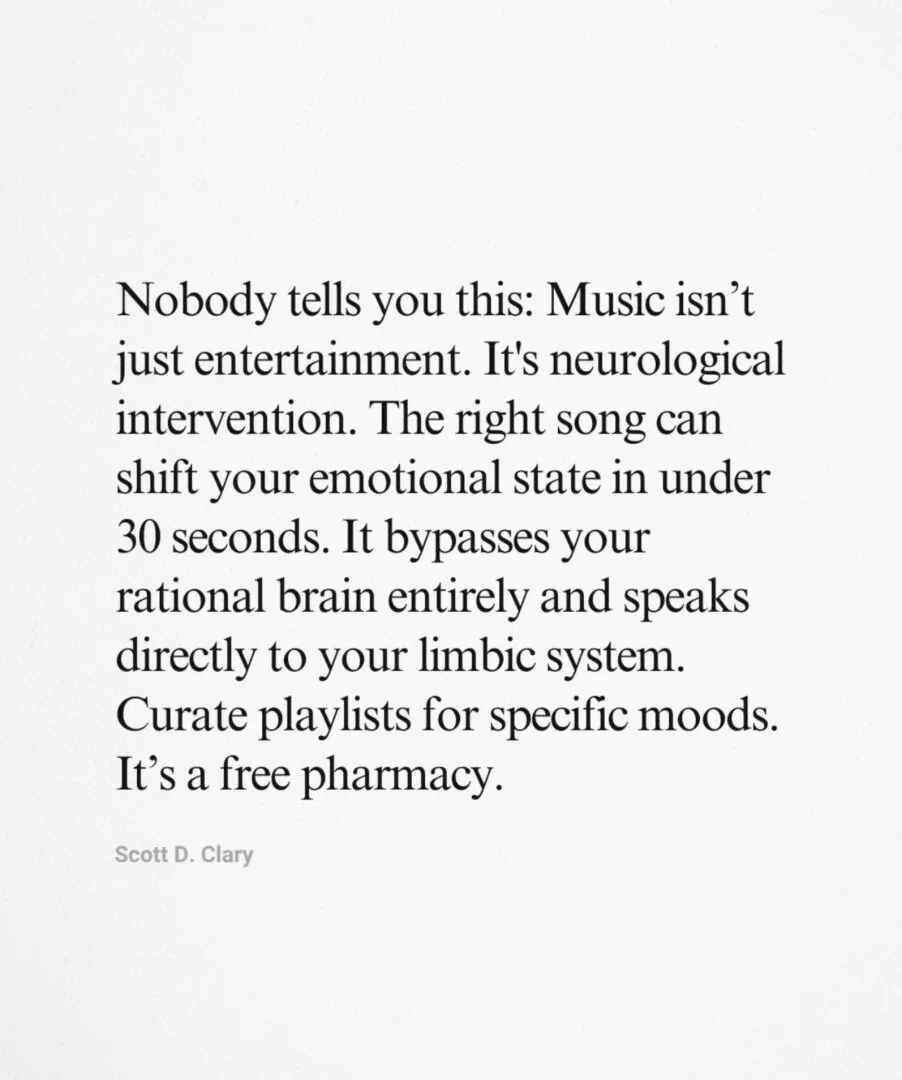
I recently came across a comment shared by Scott D. Clary: music can act as a neurological intervention, and the right song can shift your emotional state in as little as 30 seconds.
That immediately resonated with me because it is so true in my life—and for so many people I know.
Want to feel confident and powerful? Put on some Beyoncé.
Want to slow down and relax? Try the Eagles or The Lumineers.
Need motivation for a workout? Bad Bunny or AC/DC might do the trick.
Music can energize us, calm us, transport us back in time or help us express something we can’t quite put into words. Sometimes, the right song really can change the direction of your entire day.
This isn’t just a feeling or personal experience. The therapeutic use of music dates back to ancient civilizations, and music therapy became a recognized clinical profession in the mid-20th century. During World War II, musicians played for wounded service members experiencing physical and emotional trauma. Doctors and healthcare professionals began noticing the positive effects music had on their recovery, helping the field gain momentum during the 1940s and 1950s.
Today, music therapy is an established discipline connected to neuroscience, brain imaging and clinical care. Activities may include playing an instrument, singing, writing or composing songs, listening to music, or even moving and dancing to it.
Depending on the person and the setting, music therapy may help:
- Reduce stress and anxiety
- Ease pain and physical tension
- Support emotional expression
- Improve mood and overall well-being
- Strengthen memory and cognitive function, including for people living with dementia
Credentialed music therapists can be found through the Certification Board for Music Therapists directory or the American Music Therapy Association.
But you don’t have to be a musician—or participate in formal music therapy—to experience some of the everyday benefits of music.
Need to relax? Create a playlist filled with songs that help you slow down and breathe.
Need to shake off some stress? Build a playlist that makes your body want to move.
Have feelings you need to work through? Try writing a song, even if no one else ever hears it.
Or maybe it’s time to learn an instrument or pick up the one that has been collecting dust in the corner.
When I think about why music has such a powerful effect on us, I can’t help but think about the soundtrack of my own life.
For as long as I can remember, music has been a constant in my life. Growing up in the ’80s, the soundtrack of my childhood included hours of my parents’ country music on family road trips—with no headphones, iPads or other distractions to save me. At the time, it felt like suffering, but somewhere along the way, I came to love ’80s country.
Back home, MTV introduced me to a whole different world. I was mesmerized by the music videos and how a song could tell an entire story in just a few minutes. I still remember getting my first album—Michael Jackson’s Thriller—in 1982 and sitting by the radio to record my favorite songs onto mixtapes for myself and my friends. I would wait patiently, hoping and praying the DJ wouldn’t start talking before the song ended. If you grew up during that time, you know the struggle!
Those memories remind me that the therapeutic power of music isn’t limited to a clinical setting. Music captures moments, connects us to people and places, and helps tell the story of our lives. Even today, a familiar song can make us nostalgic and shift our mood, thoughts or feelings in an instant.
Music doesn’t have to solve everything to make a difference. Sometimes, all it takes is one familiar beat, one meaningful lyric or one favorite song to help us feel a little more like ourselves again.
So, what song can change your mood in 30 seconds?